Real Estate Farming Postcard Scripts
(Proven Messages You Can Mail Today)
Why Scripts Matter | The Simple Framework | Ready-to-Mail Scripts | How to Rotate Them | Personalize | Stay Consistent

Real estate farming postcard scripts solve the one problem that stops most agents cold:
“What do I actually say on the card?”
Not design. Not printing. Not postage.
Words.
Because once you’ve picked your farm, sized your list, and locked in your mailing rhythm, the only thing left is message.
Good news: you don’t need to be clever. You just need to be clear.
This guide gives you simple, proven scripts you can copy, paste, and mail today.
Step 1 — Why Scripts Beat “Trying to Be Creative”
Most agents overthink postcards.
They try to design something cute, fancy, or different. If you want a quick breakdown of what actually works, focus on keeping your cards clear, readable, and effective.
That’s the wrong goal.
Farming isn’t about creativity. It’s about recognition.
Your farm doesn’t need new ideas every month.
They need to see your name again and again until you feel familiar.
Simple messages win because they’re:
- fast to produce
- easy to read
- clear at a glance
- repeatable every month
So instead of writing from scratch each time, use a small set of scripts and rotate them.
Step 2 — Use This Simple Postcard Framework
Before we jump into examples, here’s the structure every farming postcard should follow.
Postcard Formula:
Headline → One clear message → One proof point → One call to action → Your photo & contact info
That’s it.
If your card has more than one main idea, it’s too busy.
If someone can’t understand it in five seconds, it won’t work. Strong headlines do most of that heavy lifting, so pull from a set of examples that give you clarity that pops.
Stick to one purpose per card and you’ll get more calls with less effort.
Step 3 — Ready-to-Mail Real Estate Farming Postcard Scripts
Below are plug-and-play messages. Swap in your farm name and contact info and you’re done. If you want even more phrasing options that spark responses, keep a small library of wording examples you can pull into your rotation.
Market Update Script
Headline: Homes in [Neighborhood Name] Are Selling Fast
Body: 7 homes sold last month with an average price of $412,000. If you’re curious what your home could sell for, I’ll send you a free value report.
CTA: Text or call for your update.
Just Listed Script
Headline: Just Listed in Your Neighborhood
Body: A 3-bedroom home on Oak Drive just hit the market. Buyers are actively looking here. Thinking of selling soon? Now may be your moment.
CTA: Call me for details.
Just Sold Script
Headline: Another Home SOLD Nearby
Body: This property sold in 9 days. Demand is strong and inventory is low. If you’ve considered moving, you might be surprised what buyers will pay.
CTA: Request a free home value.
Helpful Tip Script
Headline: 3 Easy Ways to Boost Your Home’s Value
Body: Fresh paint, landscaping, and decluttering can add thousands before you list. Want my full prep checklist?
CTA: Text “CHECKLIST”.
Offer Script
Headline: Curious What Your Home Is Worth?
Body: I provide free, no-pressure home value reports for neighbors in this area. No obligations. Just data.
CTA: Scan the QR code or call today.
Notice something?
Nothing fancy. Nothing clever. Just clear, useful messages.
Step 4 — Rotate Scripts With Your Mailing Schedule
Now plug these into your monthly plan.
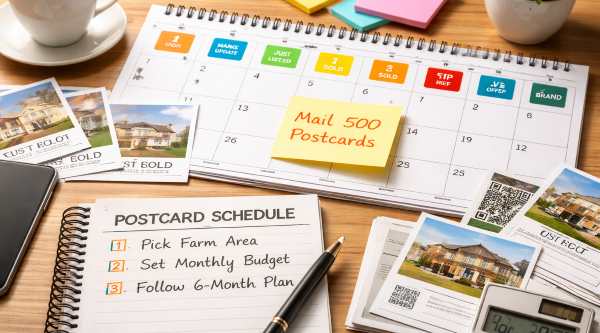
If you’re following a six-month cycle, it might look like this:
- Month 1 → Market Update
- Month 2 → Just Listed
- Month 3 → Just Sold
- Month 4 → Helpful Tip
- Month 5 → Offer
- Month 6 → Personal/Brand card
Then repeat.
This keeps your content fresh without reinventing anything.
And if you’re unsure how often to send each piece, review your mailing cadence so your rhythm stays consistent.
Step 5 — Customize Without Rewriting Everything
Here’s where smart farming gets even easier.
You don’t need brand-new copy every month. You just need small local tweaks.
Think of each script as a template, not a finished piece.
Swap in hyper-local details so homeowners instantly feel like the card was made for them:
- street or subdivision names
- recent neighborhood sales
- days on market stats
- school zones or community features
- “3 homes sold on Maple Drive last month”
Those tiny specifics dramatically boost response because they signal, “I actually work here.” And if you want an easy way to stay in touch after someone responds, keep a simple follow-up system that runs automatically.
Generic sounds like marketing. Local sounds like expertise.
So keep the core script the same. Just personalize the details. That’s the sweet spot between speed and credibility.
Step 6 — Stay Consistent and Let Familiarity Do the Work
Here’s the truth most agents miss:
One brilliant postcard won’t change your business.
Twelve simple postcards will.
Farming works because neighbors see you. And if you want that familiarity to feel intentional instead of accidental, build a look and message your farm instantly recognizes:
- again
- again
- and again
Until calling you feels natural.
So don’t chase new ideas every month.
Pick your scripts. Follow your schedule. Mail consistently.
Boring is profitable.
Want the full strategy that ties everything together? Visit the main postcard hub on your site.
Strategic Pages To Read
These three pages deepen your farming strategy and help you turn postcard responses into real conversations.
- Real Estate Prospecting Letters: Proven Scripts That Get More Responses
- Real Estate Business Cards: Smart Designs That Build Recognition
- Email Marketing for Real Estate Agents: How to Turn Leads Into Clients
Next Steps in Your Farming Plan


Home > Real Estate Postcards > Real Estate Farming Postcard Scripts
🔥Top Pages in August 2026

💌 Expired Listing Letters →
Send the message that gets sellers calling you back
📝 Email Marketing for Real Estate Agents →
Send emails that spark replies and start real conversations
🏷️ Real Estate Agent Directory →
Get discovered by buyers, sellers, and referral partners searching for agents
🏷️Real Estate Marketing Talk Blog →
Get fresh ideas that help agents grow, connect, and win more business
📬Real Estate Website Content →
Simple System. Uncommon Results.
🚪 Your Gateway to Targeted Insights

👔 For Agents →
Branding tips, lead gen strategies & marketing tools to grow your business
🏡 For Buyers → Smart buying guides, market insights & negotiation tips for your next move
📦 For Sellers → Listing prep, pricing strategies & proven tactics to sell fast and profitably
💰 For Investors → ROI-focused content, property analysis tools & market trend breakdowns