Expired Listing Letters That Position You as the Agent Sellers Call First
The Opportunity Most Agents Miss
Every day listings expire. Most agents chase them with cold calls, scripts, and pressure. You won’t.
With the right letters — sent with consistency and purpose — sellers recognize your name, trust your message, and call you first. No chasing. No convincing. Just appointments that feel natural and conversations that move.
Why Most Agents Fail With Expired Listings
- They send one letters, flyer or postcard and quit
- They cold call and sound desperate
- They forget to follow up
- They blend in with every other agent
Expired listings don’t convert because of talent. They convert because of consistent follow-up — and it doesn’t have to feel like a chasing game.
Stop Chasing Sellers. Start Attracting Them.
Most agents prospect expired listings like this:
- Cold calling strangers
- Getting ignored or rejected
- Trying to “convince” sellers to meet
- Competing with five other agents for attention
This system flips that completely.
- Sellers recognize your name
- They’ve already read your message
- They feel familiar with you
- And they call you first — often expecting to work with you
That’s a very different conversation.
Not persuasion. Not pressure.
Just, “When can you come by?”
It’s simple: no guessing, no writing, no “what do I send next?” — just follow the schedule.
The 14-Day Expired Listing Letters Follow-Up System
Here’s the exact 14-day schedule — what to send and when — so you always know your next move.
Day 1 — Introduce Yourself as the Professional Alternative
A calm, credibility-first letter that positions you as organized, communicative, and proactive — the opposite of the agent who just failed them.
Day 3 — Show Your Marketing Muscle
Demonstrate the real resources behind you — MLS exposure, advertising, networking, and promotion that most agents never deliver.
Day 5 — Bring Buyers to the Conversation
Let sellers know you’re already working with active buyers in their price range and neighborhood, creating immediate relevance.
Day 8 — Offer a Fresh Strategy & Personal Review
Provide a quick market evaluation and invite a low-pressure conversation about a smarter pricing and marketing plan.
Day 11 — Stay Visible & Consistent
Reinforce reliability through steady, professional follow-up so your name feels familiar and trusted.
Day 14 — The Respectful “Takeaway” Letter
A professional final note that steps back gracefully — often prompting sellers to call before the opportunity disappears.
What You Start Seeing Almost Immediately
- 📞 Sellers call YOU after receiving your expired listing letters — instead of you chasing them
- 📅 Listing appointments feel smoother and easier
- 🤝 Trust is already built before the first conversation
- 🏡 More signed listings with less effort and less resistance
Many agents see callbacks within days.
Bonuses That Make It Foolproof
These extras remove the guesswork, tighten your follow‑up, and make the entire system easier to execute — even on your busiest days.
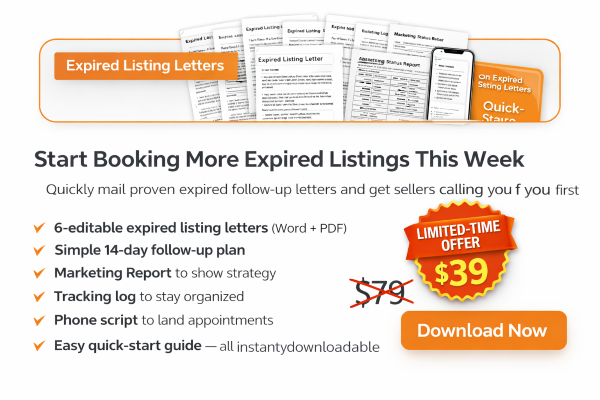
- Tracking Log — stay organized
- Marketing Update Report — show your strategy
- Phone Script — know exactly what to say
- Quick-Start Guide — launch in under an hour
If You Wait… You Lose
- Sellers relist with someone else
- Motivation fades
- Your pipeline dries up
- Competitors grab listings that should’ve been yours
Expireds are time-sensitive. Speed wins.
Stop Hoping for Listings — Start Engineering Them
Frequently Asked Questions About Acquiring Expired Listings
1. Are expired listings still worth pursuing in today’s market?
Absolutely. Even in fast-moving markets, homes expire due to pricing errors, poor marketing, weak communication, or lack of strategy. These homeowners are often the most motivated to relist quickly with an agent who has a better plan.
2. How often should I contact an expired listing?
Reach out immediately, then follow up consistently for the first 2–3 weeks using a mix of calls, letters, and texts. Persistence wins.
3. Do expired homeowners get bombarded with mail?
Yes — which is why your message must stand out. Personalization and clarity beat generic postcards every time.
4. What’s the easiest way for new agents to compete for expired listings?
Focus on speed, follow-up, and offering a clear plan. Most agents quit too early. Consistency alone gives you an edge.
5. How long does it usually take to see results with expired listings?
Many agents get appointments within days. With steady daily outreach, expect reliable results within 30–60 days.
Try it risk-free for 14 days. If it’s not for you, get a full refund—no questions asked.
More High‑Impact Prewritten Letter Sets
When your message is sharp, relevant, and timed right, sellers respond. These prewritten letter sets give you plug‑and‑play scripts that open doors, spark conversations, and position you as the agent who shows up with value—not noise.
- FSBO Letters — value‑driven messages that earn trust and open conversations with DIY sellers.
- Power Real Estate Letters — high‑authority templates that elevate your positioning instantly.
- Circle Prospecting Letters — neighborhood‑focused scripts that build recognition and inbound leads.
- Just Listed Neighborhood Letter Kit — momentum‑building letters that turn one listing into multiple opportunities.
- Real Estate Buyer Letters — targeted messages that help you attract motivated buyers and match them to your pipeline.
Home > Real Estate Letters > Expired Listing Letters